Showing posts with label Problem Solving. Show all posts

Elisabeth Morrow Students Take First Place Team Trophies in Every Grade Level at Inaugural Math Contest.

4th Grade Winning Team:
Reha, Cameron, Oren and Sangmin


by Evan Brown
Director of Communications and Alumni

On Monday April 30, The Elisabeth Morrow School hosted the first-ever, elementary Math League Contest to take place in Northern New Jersey.  The contest, organized by EMS Math Chair Carol Toth for students in grades 3 through 6, was administered by Mathleague.org and are modeled upon the larger MathCounts National Competitions. 

The Elisabeth Morrow Math scholars faired exceptionally well, garnering first-place, all-around trophies in 3rd, 4th, 5th and 6th grade, making a clean sweep of all divisions. In addition, the EMS team registered two 1st place individual winners: Peter Staphos (in grade 3) and Dylan Rhee (in grade 5).  As well, Dylan was the highest individual scorer for the entire competition.  Elisabeth Morrow also had the highest overall team score from its all-girl, sixth-grade team:  Stephanie Li, Emily Yu, Kira Trout and Chrissie Anagnos. The team was coached by EMS Math teacher, Sarah Ehatamm.

MathLeague.org competitions consist of several challenges that require a variety of math skills and abilities.  Students are tested through mental-math problems, group problem solving, sprint rounds featuring multiple choice, and targeted rounds that allow for the use of approved calculators.  The competition fielded teams from a number of prominent regional independent schools, including: Princeton Academy, Solomon Schechter, The Wilson School, The Peck School, Far Hills Country Day, Rumson Country Day and The Red Oaks School.  In all Elisabeth Morrow hosted 175 students for the afternoon competition.

Engineering Cars in Prekindergarten


by Beth Brennan
Director of Early Childhood Programs


Wood was cut and holes were drilled, all in preparation for a very special design project last week in our Pre-K class.  The children were challenged by their teachers to come up with designs for wooden vehicles that move.  Once the designs were in place, the students set out to sand, stack, build and glue pieces of wood together to make their cars.  Vocabulary like axles, wheels, and hub caps were incorporated in the building portion of the lesson. In projects like these, the process is as important as the end results; the children start with imagination, followed by the development of a plan, then trial and error. Once assembled, as you will see in this video, they had the opportunity to talk about their ideas and, best of all, test their vehicles. 

John Hunter and World Peace Game


by Aaron Cooper
Assistant Head of School

Click Here to see TED talk
I had the opportunity to attend a talk by John Hunter, 4th grade teacher and TED speaker, while at the National Association of Independent Schools Conference in Seattle.  Mr. Hunter spoke about his World Peace Game, developed over the course of his 30 year career. From his website, the game is described as a "hands-on political simulation that gives players the opportunity to explore the connectedness of the global community through the lens of the economic, social, and environmental crises and the imminent threat of war (1)." From my perspective, this wonderful game establishes high expectations while giving students an opportunity to collaborate, create and solve "real-world" problems, as they work toward "winning."  

Good teachers think alike it seems.  Mr. Hunter's talk made me reflect upon the game-like initiatives we already have in place at EMS.  Ms. Malmstrom's tech curriculum involving MMOG's like Minecraft or Quest Atlantis, and Mr. Penny's City Game come to mind as similar, middle-school examples.  But "immersive" games like these happen across each grade level at our School. Mr. Hunter's World Peace Game (as well as our own games), when you see them in action, are refreshing reminders of what children can achieve when given an engaging and dynamic framework to think critically and collectively.

You don't have to take my word for it though; you can watch Mr. Hunter's TED talk or review his World Peace Game Foundation website if you would like more information.  As well, the game serves as the backdrop for a new movie debuting on PBS this Spring, called World Peace and Other 4th Grade Achievements.  To watch a trailer of the film, click here.

Game to Learn


by Marianne Malmstrom
EMS Technology Teacher

Winter 2012
 
“21st Century Learning” and “21st Century Skills” are two of the most commonly used phrases in education today, but what do they really mean?  More importantly, what do they mean in terms of your child’s success?
    When hearing the term “21st Century Learning,” many conjure images of fancy computer labs and classrooms equipped with smart boards.  Others think in terms of cutting-edge software and Web 2.0 tools that allow students to create, collaborate and publish online.  While these are all tools that are reshaping our culture, simply learning how to use them does not prepare students to successfully adapt to a constantly changing world. The heart of “21st Century Learning” is not about the tools, it is all about learning how to learn. Helping our students become proficient and independent life-long learners is central to their success in navigating through uncharted change.
    Pat Bassett, President of the National Association of Independent Schools, identifies five essential skills for success in the 21st Century: creativity, critical thinking (problem-solving), communication, collaboration and character (citizenship).  While these skills do not always get the priority they deserve in a culture largely driven by content mastery and test scores, they have always been an integral part of our mission at The Elisabeth Morrow School.  Following that mission has served us well in navigating rapid change and keeping our program relevant.  Before adopting new technology or creating new curriculum, we always measure how well it will help us achieve those fundamental goals.
    Over the last ten years, emerging technology has opened new modes for communication.  Our school responded in 2003 by creating curriculum designed to help students understand and use multimedia effectively.  We felt it was important that students be able to express their ideas as clearly and persuasively through images, sound and video as they do using the written word.  Knowing that technology would continue to evolve, we chose to focus on fostering the skills of communication rather than teaching how to use specific tools.  Our early work in this field was ahead of the curve and, subsequently, has earned us a reputation as a leader in teaching media literacy.  That curriculum continues to serve our students well today.
    As we move forward, we constantly look for authentic ways to bridge technology with opportunities to develop essential skills and proficiencies in learning.  One of the most unexpected vehicles for doing this is through the use of games.  At first, this may seem counterintuitive, as we tend to think of school as being a sanctuary for serious work.  While we may not think of games as serious, there is much that they can teach us about learning.  In fact, they offer a unique platform to address all five skills that Mr. Bassett identified as essential for success.  More important, a well-designed game engages the player in a constant cycle of learning.  As players master each new level, they are skillfully guided to tackle more complex tasks.  The challenges are carefully structured to build skills by having players apply previously gained knowledge to new problems.  If you have ever played a game or watched a gamer play, you have observed the inordinate amount of time that can be spent on mastering a new challenge.
 
New Media: Goldmines for Learning

In 2009, the National Telecommunications and Information Administration formed an “Online Safety and Technology Working Group” to promote online safety for children.  The committee’s recommendations called for children to work online with trusted adults in order to help them form healthy and safe norms.  Think of it in terms of learning to drive a car.  We do not give teenagers a few lectures on driving safety, throw them the car keys and turn them loose.  That would be insane.  Instead, we spend a great deal of time teaching, modeling and driving with them before they are allowed to drive independently.  We need to adopt the same attitude with technology.  By carefully selecting technology that young people use in their everyday lives, we can leverage those platforms to engage students, develop essential skills and learn core subjects while modeling appropriate behavior. 
    Virtual worlds and massively multiplayer online games (MMOGs) are two platforms that can help us accomplish these goals.  Students love them and innovative educators see these spaces as goldmines for learning.
    Virtual worlds are 3D spaces that allow users to interact with each other using avatars.  These spaces give students a unique opportunity to participate in creating their own learning environments.  Each world typically starts with land, sky and water and is programmed with a physics engine that simulates gravity, weather and light cycles.  Users transform the landscape and create all of the buildings, vehicles and other objects that populate that space.  These objects can be programmed to perform behaviors that interact with the environment and the other avatars.  The complexity of each building is only limited by the user’s imagination and skill.
    Lessons within a virtual world typically start with a simple challenge, such as designing a community center.  Things quickly become complicated when constraints are added, such as limiting the number of building units students are permitted to use or insisting that everyone agrees on the design before the building starts.  Students love the opportunity to stretch their imagination and show what they have created.  The complexity of their building grows as they become inspired by each other.  It is amazing to watch how freely they share their newly gained knowledge.  There is a constant buzz, as students move about the room helping each other and sharing what they have learned.  The work is so complex that it is impossible for anyone to be an expert in all areas.  The community only thrives when each member contributes his/her area of expertise to the group.  Arising conflicts and disagreements become part of the learning process, as students negotiate and resolve their own problems.
    MMOGs provide a different kind of learning opportunity.  Using scripted stories, these platforms allow players to interact with others online as they complete challenging tasks within a storyline.  Since many quests require a team to successfully complete the task, the ability to collaborate, communicate and solve problems is critical.  Each character specializes in a specific set of talents.  Players have to manage a great deal of information and adeptly juggle multiple skills in order to play optimally.  Much like sports, team challenges are only successful when each member performs his/her job well.  These games are highly engaging and incredibly complex.


What Makes a Game a Learning Tool?

In choosing MMOGs, we look first at safety followed by what the game will deliver in terms of complex, engaging and imaginative play.  For grades 4–6 we have been using Quest Atlantis, a game designed exclusively by educators.  The platform allows students to interact with teachers and students from around the world, as they help the “Atlantians” rebuild their “Arch of Wisdom.”  In Middle School, World of Warcraft offers a more sophisticated storyline with all the action required to engage young teenagers.  But, do not be fooled!  Just because it is fun does not mean that there is not complex learning taking place.  Students have to learn teamwork quickly to make progress, and there is little tolerance for “slackers.” 
    We have added two new games this year, LEGO Universe and Minecraft.  Both represent a new kind of game design that is a hybrid of virtual world and MMOG, offering a mix of scripted play and the ability for the user to create content.
    LEGO has raised the bar for online play with their first MMOG.  LEGO Universe is a graphically beautiful game designed to inspire creativity.  The storyline calls for players to work together to “save imagination.”  Similar to other MMOGs, players customize their characters and specialize in a specific set of skills.  Diversity is always helpful when teaming up to complete complex tasks such as smashing dragons.  LEGO breaks away from traditional MMOGs by giving players their own property where they can build using virtual LEGO bricks.  Additionally, basic programming skills are introduced as players give their creations “behaviors” using a child-friendly interface.  All of this is done with safe play as a first priority.  Chat is kept appropriate through a game filter that allows only pre-approved vocabulary.  Community monitors are online 24/7 to keep an eye on the play and immediately address any complaints of abuse. 
    We use LEGO Universe in grades 4–8.  One of the most fascinating things to observe is the role-playing that takes place both in and out of the game.  This is true no matter what the age.  There is a constant level of chat as players move seamlessly between stepping into the role of the character and back to reality in order to discuss strategies and provide help to fellow players.  Once, the entire class spent over 30 minutes working together to complete a single group challenge.  They continued to work as a team, repeating the task several times until everyone earned the achievement.  Online games are often thought of as solo activities, but nothing could be further from the truth when playing MMOGs.
    Minecraft is one of the most unusual and compelling platforms that we use.  When you first look at the archaic graphics it is hard to imagine why students are so passionate about this game, but they are. It is actually more of a virtual world than a game because there is no story or script. What sets it apart from other virtual worlds is the constant threat of danger.  The day/night cycle is accelerated to intervals of 15 minutes, and when it is dark the monsters come out.
    Each Minecraft world starts as an untamed wilderness filled with creatures both docile and dangerous.  Players “mine” the materials required for construction and “craft” tools needed for building and survival.  Resources may be scarce or hard to locate.  One runs the risk of losing everything that has been collected if his/her avatar is killed. There are plenty of opportunities for players to stretch their imaginations if they can find the resources and survive the monsters that lurk in the dark.
    The open nature of play in Minecraft is excellent for schools. Learning to build is easier than most other virtual worlds.  This makes it accessible for younger players.  Additionally, private worlds can be created for each class and customized according to specific goals.  Monsters can be turned off, and players given unlimited resources for building.  We currently use Minecraft with grades 4–8 but have plans to introduce it in grades 2–3 later this school year.
    Worldwide, Minecraft has generated one of the most creative and innovative communities in gaming.  Dr. James Paul Gee, Professor of Literacy at Arizona State University, maintains that the real literacies for the 21st Century are developed within these interactive communities that grow beyond the game.  We have observed that with our own students as well.  They like to research changes in the new updates and compete to find the coolest “mods” (programs created by community users to modify the game).  Students often approach us with suggestions for game play or ideas for projects.  They watch videos online documenting incredible feats of construction and then try to emulate them in class.  While we maintain project wikis to document the work we do on all platforms, some of the Minecraft students have taken ownership of their wiki, customizing it to meet their needs. 


Powerful Results

Educators are becoming increasingly interested in understanding the connection between playing games and learning.  Over the last three years, our students have shared their work at four international online education conferences.  They were also invited to speak at a conference held at Kean University.  Teachers at The Elisabeth Morrow School are welcomed to play with the students as part of their on-going professional development.  It is a positive opportunity for both students and teachers to interact in a way where their roles (as teachers and students) can be interchangeable.  In this way, games level the playing field for learning.  Adults can find it extremely humbling the first time they play a MMOG.  They typically walk away with a new insight about the complexity of the game, gaining appreciation for the skills it takes to play successfully.
    It is important that parents also understand this technology.  If we are to help children develop healthy and safe norms online, we need the entire community involved.  At school, we provide safe spaces and play alongside our students.  Students want to continue to play at home and often ask parents to create accounts or purchase the games that we use in school.  As always, it is important that parents be aware of where their children play online.  We encourage parents to ask questions, observe play and even join the game. 
  Virtual worlds and MMOGs hold some important keys to keeping our schools relevant in a rapidly changing world.  We have observed and documented the learning that takes place in these unusual spaces.  It is clear that they are conducive to fostering essential 21st Century Skills.  Students find working and playing in these spaces highly engaging.  When given a challenge, they often exceed the expectations of the assignment.  Beyond the academic lessons, students just want to play.  When they are given the time and opportunity to do this, they astonish us with the complexity of their ideas and how much time they are willing to invest in making them a reality.  It is powerful to watch them take ownership of their own learning as well as take responsibility for solving their own problems.  Clearly, play is an essential part of learning in the 21st Century.

Intuitive Mathemeatics: Problem Solving at The Elisabeth Morrow School


By Aaron Cooper
Assistant Head of School


Summer 2010

My grade 9 students have difficulty appreciating the usefulness of the standard form of the equation of a line, prompting them to ask, ‘When are we ever going to need this?’ This question used to really bother me, and I would look, as a result, for justification for everything I taught. Now I say, ‘Never. You will never use this.’ I then go on to remind them that people don’t lift weights so that they will be prepared should, one day, [someone] knock them over on the street and lay a barbell across their chests. You lift weights so that you can knock over a defensive lineman, or carry your groceries, or lift your grandchildren without being sore the next day. You do math exercises so that you can improve your ability to think logically, so that you can be a better lawyer, doctor, architect, prison warden, or parent.  Math is mental weight training. It is a means to an end (for most people), not an end in itself.
~Dan Sherman  
(from the book “Made to Stick: Why Some Ideas Survive and Others Die” by Dan and Chip Heath)


The Three-Year-Old Program
How Can I Find Out?

On a May morning, a student entered her classroom to find a small group of classmates playing in the sandbox.  She counted five children (including herself).  She asked her teacher how many students had not yet arrived at school.  The teacher asked her if she could think of a way to find the answer to that question.  The student thought for a moment before walking to the cubby area.  After remembering which students were playing in the sandbox, she began counting the cubbies of the children who were not present.  Once she finished, she proudly announced that nine of the children had not yet arrived.  The teacher asked her how she came up with that number.  The student said she counted the cubbies of the nine missing children.  When she added those nine to the five children present, the answer was the magic number, fourteen (the total number of students in the class).


Kindergarten

Would I Be Able To?


Taking polls and making graphs has been a focus for the kindergarten students throughout the year.  Students are asked to answer questions by placing a colored cube in the appropriate column in a bar-graphing board.  For example, this year students predicted whether certain liquids would freeze in the winter (juice and paint, yes; oil, no) and in another example, identified their preferred Jack-O-Lantern face, scary or happy (scary was preferred by a landslide). 

One student in the class was planning a birthday celebration.  He wanted to make cupcakes for his class, frosted with each student’s favorite flavor.  He brought colored stickers and a list of his classmates to school one morning and set about taking a poll.  His teacher asked him how he was going to keep track of the group’s preferences.  Remembering his experience with graphing, he decided to use the same method to keep track of his classmates’ frosting choices for his special day.  He offered the choices, used the bar-graphing board along with the cubes his class had used all year long, and graphed the results.  The student noticed that chocolate was the most popular frosting, and his graph made it possible to see at a glance how many cupcakes of each flavor were required.


Grade Two
Did I Do Something Like This Before?

In second grade, our children develop problem solving skills in geometry by learning to identify and name various shapes.  In one activity, the students were given a set of four triangles and four rectangles previously cut from a four-inch square of paper.  The students were asked to name the shapes they saw and identify similarities and differences between them. 

The class agreed that all the triangles were congruent (in their words, “exactly the same size and shape”) and noticed that all the rectangles were congruent as well.  Then, the students were given a pair of scissors and a new, unmarked four-inch square piece of paper and asked to cut four congruent triangles and four congruent rectangles from it with no leftover paper (fig.1).  Teachers noted that there was plenty of extra paper, if needed.

Some students got to work folding and cutting by trial and error.  Others tried to envision the problem before beginning to cut.  One student tried to start cutting out shapes approximately the correct size.  After getting two triangles and two rectangles, none exactly the same, she was left with scraps of paper littering her desk.  A teacher approached her, and they started a discussion.  The teacher asked if she remembered the quilting squares project they completed a couple of week before.  The student did.  “Now, what shapes were on that quilt?  How did you make those shapes?”  The student remembered that there were rectangles and triangles and that she had folded the paper first before making her quilting design.  Off she went, folding and cutting.  Five minutes later, she proclaimed happily, “I got it!” and showed off her eight shapes with no leftovers. 


Grade Four
Is There A Pattern?

On a beautiful June morning, fourth grade students gathered in the Grace Muller Courtyard to work on a problem about King Arthur selecting a knight to marry his daughter.  At first, there were thirty knights around the table.  King Arthur eliminated every other knight, starting with the second knight and continuing around the table until there was only one knight left.  What was the seat number of the lucky knight?  

Students scattered in pairs around the courtyard, armed with sidewalk chalk and a copy of the question.  They drew circles, made slashes, used multiple colors and checked their work using different methods.  When they gathered together five minutes later, most had determined that seat #29 was the lucky seat.  

The second part of the problem asked students to figure out a winning strategy for a more complex game. If I were a knight wishing to be chosen to marry the king’s daughter, and I did not know in advance how many knights would be at the table, is it possible for me to figure out where is the best place to sit?  Can I show up the day of the competition, count the knights, think for a minute, and then take a seat that I know will make me the winner? 

Before the students got to work, the teacher asked what strategies they might use to solve problems like this.  Students called out possibilities.  “Draw it!” said one.  “Try to find a formula!” and “Use a calculator!” said others.  The teacher asked if the students remembered how they had solved a recent problem called, “The Ice Cream Problem.”  A student said, “We tried to find a pattern;  maybe that will work here.”  The teacher agreed.  

When the students scattered to begin searching for the pattern, they agreed on a systematic approach to solving the problem: start with one knight at the table, continue adding a knight and tracking the “magic” seat until a pattern emerges.  

It is quite a complex pattern but the students were able to get at it bit by bit. First, they noticed that the first knight wins again and again. Then, the students noticed that an ever-increasing sequence of consecutive odd integers gave the place of the winning knight. As can be seen in fig.  2, the odd integers, starting with one, repeat themselves to give the place of the winning knight. Each time, the string of odd integers lengthens. Eventually the students noticed that the first knight wins when there are two knights, four knights, eight knights….. and on and on as the number of knights doubles, beginning with two. 

After much discussion, they learned to predict the correct seat for a given number of knights.  While not explicitly writing a formula, the students realized that they needed to find the highest power of two that was a part of the number of knights at the table. The number left over from that power of two was the winning position!  Explicitly formulating the problem would require the use of logarithmic functions, a high school math topic often learned in pre-calculus courses.

Nevertheless, our fourth graders were able to appreciate the pattern and use it to model the problem.  This kind of thinking lays the groundwork for a much deeper understanding of such problems when encountered in more advanced classes, where the actual formula will be the end product of the exercise.


Grade Six
There Must Be An Easier Way

A sixth grade class starting their study of permutations and combinations had completed the following problem for homework: “The digits 1,2,3, and 4 are written on slips of paper and placed in a hat.  A three-digit number is drawn at random from the hat.  What is the probability that the three-digit number is divisible by the number three?”  

Students presented their methods for solving the problem:  “I wrote out all the possibilities of a three-digit number – there are 24,” and “I did 4! (four factorial - i.e., 4x3x2x1) to determine 24 possibilities.”  Another student noted that each number sequence (such as {1,2,3}) had six possible combinations and that no matter the order, each of those numbers will be divisible by three.  {2,3,4} was another set of numbers divisible by 3 with six combinations.  So, the class agreed that the answer was ½: 12 out of the possible 24 combinations would be divisible by three.  

During the ensuing conversation about how students checked their answers, a hand shot up from the side of the classroom.  “What if there were 1,000 numbers in the hat instead of four?”  Mathematicians love this type of question.  They call it the “natural” next step, a more difficult question of the same type.  The teacher, knowing that this is what mathematicians do, engaged the question. “Okay,” she said, “Let’s change it.  Instead of four digits in the hat, there are ten.  Zero through nine.  The other parameters are the same.  Get to work.”  

The students began by using the tried-and-true method from the original problem, writing out all the possible number sequences that are divisible by three.  As students called out numbers and the teacher wrote them on the board, some students began to wonder if they’d chosen the best method.  They asked, “How can we be sure that these are the only possibilities?” and “Is there a better way to do this?” “All this work, and we’ve probably got it wrong,”  said some.  Though the students made good progress on the problem, they soon discovered that their original methods were unreasonably time consuming and difficult for this extended problem. In the end, they were close.  The students found forty sequences divisible by three, yielding 218 combinations.  There are, actually, forty-two sequences yielding 228 combinations and a probability of 19/54 (approximately 35%) of getting a number divisible by three.  

When mathematicians encounter a similar issue – known methods being overly cumbersome, they have two options: automate the original method, if possible, or develop a stronger method.  The students’ recognition that there must be a simpler way to solve the problem and subsequent attempts to identify that method is an important step in the development of their mathematical minds.  

The solution requires a more advanced form of combinatorics, usually studied in high school pre-calculus classes.  The students saw how the more advanced problem is motivated from the simpler problem.  Further, they began to explore the more advanced problem and develop techniques for solving it. Both of these experiences should deepen their understanding of the topic when they come to study it in a more formal fashion in high school.


Grade Eight
It’ll Be Some Crazy Shape…Or, Maybe, A Parabola

Towards the end of the school year, an eighth grade math class began with the following pep talk:  “You all know a lot at this point in the year. Now, can you work on a problem that could use any of the things you’ve learned? Even if I don’t tell you which of those things you’ll need to use?  Trust me, you know how to do this.  It may look strange and feel strange, but you’ll figure it out.  You know how.” 


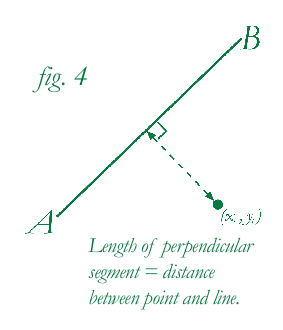
The teacher then asked students to remind one another about two concepts that they had derived the previous day: how one finds the distance between two points on a graph (fig. 3) and how to determine the shortest distance between a point and a line (fig. 4).  Afterwards, the teacher continued, “Good.  Now, suppose I have a point, F, at (0,4) and a horizontal line, l,  with the equation y=-4.  Find a point or some points that are equidistant from F and l.”  A student’s hand shoots up.  “I got one!  (0,0) is four units away from both the line and the point.” The teacher responded, “Excellent.  Now, can someone get another?”  

After a number of guesses – many close but none correct – students began thinking of the shape that might appear.  “It’ll be some sort of crazy shape...or, maybe, a parabola.” “Yeah, maybe the origin, (0,0), is on the axis of symmetry,” and “You could reflect the other points.”  The teacher re-centered them, “Okay, but so far you’re guessing.  Let’s find another point that we are sure about and go from there.”  

Another minute passed.  A different hand shot up.  “I got one! (4,1) is five units above the line and, if you use the distance formula, you find that it is also five units away from the point F.” “Very good.,” said the teacher.  Another student offered, “And its reflection, (-4,1), also works!”  Soon, another student had found two more points, (8,4) and (-8,4), that were also equidistant from F and l.  The teacher, cycling back to the students’ previous hypotheses, said, “Excellent. 

So, we have a lot of questions.  Is this a parabola?  Is it a parabola segment? Is it some sort of ‘V’ shape? What is it?  There are a variety of conjectures, but the strongest consensus is behind the idea that all the points together will form a parabola.  So, how do we confirm this conjecture? This is the next step.  Let’s take a sliding point, (x,y), that satisfies the given requirements, but that could be anywhere on the resulting shape.  Find out how far the point, (x,y), is from F and how far it is from l.”  

The students got to work.  After ten minutes of conversation, of building on one another’s ideas, of trying some thoughts that proved incorrect and others that proved helpful, the students were able to determine the distances that (x,y) is from F and l.  

They then realized that to get the equation describing the resulting shape, they would need to set the two expressions equal. The students had taken a similar approach when deriving the equation for a straight line earlier in the year. Although this problem was significantly more difficult, they were able to come to that realization with only very little reminder.

The next day, they completed the problem (fig. 5) and discovered that they had indeed derived the equation of a parabola (fig. 6).