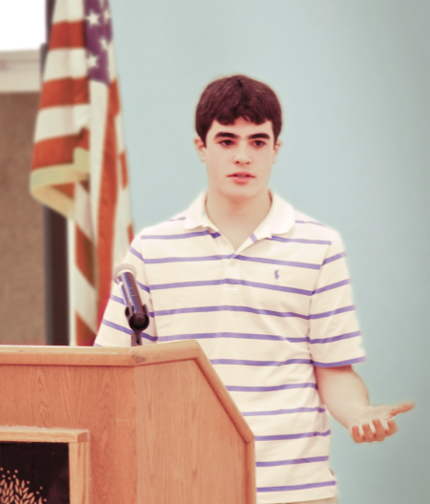
by Daniel Scher ’08
Several years ago, my family embarked on a “heritage” journey to Eastern Europe where we visited the small town in Belarus that had been my great-grandmother’s home. We walked from what had been her house toward a seemingly innocent field that looked like the perfect place for kids to run around. On this innocent field, my great-grandmother’s family and friends took their last breaths after being lined up in a pit and massacred. On that same trip, my grandfather took us to visit a small local school to which he had donated several computers. I never understood why my grandfather chose to make this donation until very recently. At the time, he told me he wanted to teach the younger generations to respect and appreciate Jews. He calmly explained that the purpose of the trip was not to remind me to hate people who had caused us pain, but to learn how to create understanding among people I’d encounter later on.
I have discovered that my grandfather’s lesson is a hard one to learn. When I stood at Auschwitz, imagining myself in a line heading towards death, my first emotions were those of anger and hatred. I thought of all the things I might have done to fight back; I felt ashamed that so many Jews had simply accepted their fate. Now, looking back on this moment, I wonder if revenge would have been satisfying. The longer I think about it, the more confused I become about the answer.
My doubts about revenge led me to think a great deal about the current situation in the Middle East. Many people profile Muslims as terrorists and killers without ever actually getting to know any of them. The media helps us to form these conclusions while ignoring the underlying facts: many people in the Middle East want peace, education for their children, prosperity and safety. Once we recognize that, we may be able to make progress towards peace in the Middle East.
My interest in the subject only intensified. I decided to attend
Seeds of Peace, a leadership development program in Maine focused on the Israeli-Palestinian conflict as well as the tensions between India, Pakistan and Afghanistan or South Asia. The goal of Seeds is to empower young leaders from India, Pakistan, Afghanistan, Israel, Jordan, Egypt, the West Bank, Gaza and America with information about the “other side” of a conflict so that young people develop the skills to see beyond stereotypes.
It’s difficult to put the experience of attending Seeds of Peace into words. John Wallach, Founder of Seeds of Peace, said, “Treaties are made by governments, peace is made by people.” From the Seeds program, I hoped to build on what I began last summer when I attended a program at Brandeis University called Genesis. Genesis focused on bringing Jewish high school students from all over the world to Massachusetts to develop a greater understanding of the diversity within the worldwide Jewish community. Teenagers from Russia, the United States, and Israel, each with a different level of faith, came together to share their Judaism. One way of doing this was a Friday night Sabbath activity (referred to as Sichot), during which two different students, usually strangers, were encouraged to talk to each other one-on-one for at least an hour. I found this technique to be very successful because I had a chance to find common ground with everyone. Once people discover the ways in which they are alike, they begin to forget the ways in which they are different. I hoped to become one of those who could embody that message and teach it to others.
In addition to looking at international conflicts, Seeds also sponsors a program to help resolve tensions between Maine citizens and immigrants from Africa. Each session has a total of 170 Seeds and this is the 18th year of Seeds, making the overall Seeds family around 4,500-people strong. Seeds of Peace is not designed to get one to agree or disagree; it is a unique process intended to be the beginning of a lifelong discussion. The entire camp is centered around the hour-and-a-half that we spend together in daily dialogue sessions. The rest of the day is spent like any other athletic camp: playing soccer, swimming, baseball, art, drama, dance, music, volleyball, etc. We all have such a great time playing sports together that, when it comes to our discussions, it is much easier to put aside our past hatreds and stereotypes.

Leading up to my time with Seeds of Peace I was feeling a combination of feelings – scared, nervous, and excited. Before I became part of the Seeds family, I thought of Palestinians and many other Arab people as suicide bombers whose goals in life were to terrorize innocent populations. As an American, I wondered what my role would be. Not being directly involved in either the Israeli-Palestinian conflict or the one in South Asia, I wondered if I would be accepted and what credibility we Americans would have in discussions. I was not sure how I would act if I were placed in the Middle East dialogue group. Growing up as an American Jew my allegiance was to the Israeli point of view. After the process, however, I learned that where my opinions fall does not matter. Arguing about events and trying to prove that you are right does not accomplish anything. What is important is being able to learn about others’ perspectives. If we want to change the world we have to be able to talk to the people who do not agree with us and understand that, for the most part, we all want the same thing: peace.
Tensions were high during the beginning of camp. When the Americans arrived, everyone, from Palestinians to Indians, were dancing and cheering. The rest of the camp thought highly of Americans. Some of the stereotypes were not very flattering, but almost everyone respected America. I was surprised how important American opinions were to them and how hard they worked to influence us. When the Israelis arrived, however, I noticed that none of the Palestinians cheered; it was very quiet. As the first week progressed, campers mainly stuck to their delegations. Israelis would spend time with Israelis, and Palestinians with Palestinians and so on. Communication was difficult because international Seeds were nervous and had trouble speaking English so they stuck to their native languages. There were times when dialogue sessions became very intense, accompanied by a lot of screaming and yelling. As camp continued, however, Seeds became more comfortable with each other and with speaking English.
One of my Palestinian friends, Yehia, came to camp to tell Israelis they were wrong. His brother worked for the government in the West Bank and was arrested 19 times by the Israelis. He was released after a mere five years because of medical reasons. Imagine growing up under these circumstances – a country you are already taught to hate has basically ruined your older brother’s life. Are you going to grow up wanting peace? No. If he had not come to Seeds of Peace, I bet he would have joined a radical party. Though he may never agree with Israelis on many issues, he became friends with Israelis and learned to understand them. He was able to put aside the horrible things done to his brother and put a human face on Israelis. His story moved me so much that at the end of that session, I went up to him and gave him a long hug. He thanked me numerous times for listening to and understanding him. Then, there was my friend Karam from Gaza. He spoke about how his neighbors died because they did not have the medicine they needed. He told us about how he gets electricity for two hours a day and does not have running water. He concluded his story by turning to me saying, “Americans have to understand our suffering and help us. My people are suffering everyday and we live like dirt. Please, Americans have to help us. We have nothing. Go home and tell people of our lives and please help us.” I was so shocked by this. Coming to Seeds I did not expect this role. I did not know what to do. Every day I worry about Karam. Two months earlier, I would have had no sympathy for either Yehia or Karam. I would not have listened to either of their stories. Now that I am home I try to message Karam everyday because I fear that something might happen to him and I would not know.
The Palestinians’ stories of suffering opened my eyes. However, just as I developed an understanding for the Palestinian side, the Palestinians developed an understanding for what the Israelis were going through. One of the Israeli girls talked about her father’s experiences in Gaza. He was the head of the economic branch and social administration and was forced to drive an armored car to work everyday. The Palestinians living there would throw stones at his car when he was driving to and from work. Another girl from Haifa now has to live in fear of a war between Israel and Hezbollah because if war breaks out, Haifa will be bombed.
Imagine having to fear for your life when doing the most basic things like driving to work. When we had to leave camp, I felt guilty coming back to my nice home in New Jersey. I appreciate the most basic things of life, like running water, electricity, and food. I know my friend in Gaza has none of these. I remember when the Northeast was hit with a terrible storm in March of 2010 and most of Northern New Jersey was out power for a week we all complained, but the people in Gaza live like that everyday. During the Gaza War, they had to live without food, water, or electricity for 24 days and we complained about six. They have electricity for two hours every day and we complain when we lose it even if it’s just for five minutes. If I want to go to the next town over, it’s a five-minute drive. I appreciate the fact that I don’t have to wait at a checkpoint.
Two of my bunkmates became amazing friends at camp. They live 15-minutes away from each other. One is Palestinian the other is Israeli so they will most likely never see each other again. Being born in America, no matter how wealthy or poor, is a gift. For the most part, we are sheltered from everyday violence that shakes other parts of the world, we are able to speak our minds and not have to worry about our safety, and we can live our lives everyday knowing that we will come home at night. Most of all, we are able to travel the world without being turned away at borders because of our nationality.
Seeds of Peace has helped me appreciate the most basic things about life, right down to where I was born. It has been an amazing, life-changing experience, not just for me but also for all the other Seeds that shared this experience with me. The most important thing I developed from Seeds was hope because I saw a transformation in the way that the kids from both sides of the conflict respected each other’s points of view.
Before I went to camp, I saw Palestinians as suicide bombers who only wanted to destroy Israel. Slowly that stereotype changed. Now, I see everyone from Seeds as someone I love, trust, and want to hear from regardless of nationality, religion or heritage. When I saw my Palestinian friend, Yehia, and the others of his delegations crying when the Israelis left camp, I realized that if one person can change, the world can change too.
Albert Einstein once said “It is easier to break an atom than a prejudicial thought.” Seeds of Peace has already broken the prejudicial thoughts of thousands of young people like me. John Wallach was right: Peace is not just a ratified treaty but rather it’s a contract between people for building a better future. Seeds of Peace teaches that the human element of peace-making cannot be ignored. It has inspired my fellow campers and me with the realization that, whatever our nationality, we share the same hopes, fears, dreams and aspirations. We all seek a future of peace.
Since camp I have spoken about my experience to numerous organizations including the students here at Elisabeth Morrow School. I plan to visit the Middle East to see my friends this summer and I hope to stay in touch with them through Facebook and Skype. I am currently looking to study a combination of political science, international relations, Arabic, psychology and economics in college. At Tenafly High School, I am an active member of both my varsity debate team and the honors marching band, thanks to Mrs. Gold.
EMS built the groundwork for my appreciation of community and the importance of accepting cultures different from my own. It was a special treat to have the opportunity to lead an assembly. I always learned a lot from the speakers at the assemblies while I was at EMS, and I have always hoped that one day I would have the ability to lead one myself. As to the person I have become, I owe much to EMS. Without Mrs. Bower I certainly would not have developed my passion for current events, history, and debating subjects which I continue to pursue in high school. Without Mr. Cooper I would not have become interested in historical texts from ancient Rome; and without Senora Bonasorte, my desire to learn foreign languages. I have continued with Spanish, I took a year of Chinese, and I started studying Arabic.
When I visited this past spring with other Seeds, I was impressed with the level of student engagement and openness in the small group discussion we had at EMS. The students opened up a lot more than I thought they would and it reflected the openness and knowledge of the community as a whole.
I would like to thank everyone on behalf of the Seeds family for donating the Middle School Founder’s Day Carnival proceeds to Seeds of Peace. It means a lot to us as an organization and a family and has meant so much to me, personally, as well.
~ Daniel Scher ’08 is a Senior at Tenafly High School