Showing posts with label 5th Grade. Show all posts

Elisabeth Morrow Students Take First Place Team Trophies in Every Grade Level at Inaugural Math Contest.

4th Grade Winning Team:
Reha, Cameron, Oren and Sangmin


by Evan Brown
Director of Communications and Alumni

On Monday April 30, The Elisabeth Morrow School hosted the first-ever, elementary Math League Contest to take place in Northern New Jersey.  The contest, organized by EMS Math Chair Carol Toth for students in grades 3 through 6, was administered by Mathleague.org and are modeled upon the larger MathCounts National Competitions. 

The Elisabeth Morrow Math scholars faired exceptionally well, garnering first-place, all-around trophies in 3rd, 4th, 5th and 6th grade, making a clean sweep of all divisions. In addition, the EMS team registered two 1st place individual winners: Peter Staphos (in grade 3) and Dylan Rhee (in grade 5).  As well, Dylan was the highest individual scorer for the entire competition.  Elisabeth Morrow also had the highest overall team score from its all-girl, sixth-grade team:  Stephanie Li, Emily Yu, Kira Trout and Chrissie Anagnos. The team was coached by EMS Math teacher, Sarah Ehatamm.

MathLeague.org competitions consist of several challenges that require a variety of math skills and abilities.  Students are tested through mental-math problems, group problem solving, sprint rounds featuring multiple choice, and targeted rounds that allow for the use of approved calculators.  The competition fielded teams from a number of prominent regional independent schools, including: Princeton Academy, Solomon Schechter, The Wilson School, The Peck School, Far Hills Country Day, Rumson Country Day and The Red Oaks School.  In all Elisabeth Morrow hosted 175 students for the afternoon competition.

Going Beyond the Classroom: Experiential Learning in our Hudson River Region


by Gary Lyon
Director of Environmental Education


Winter 2010


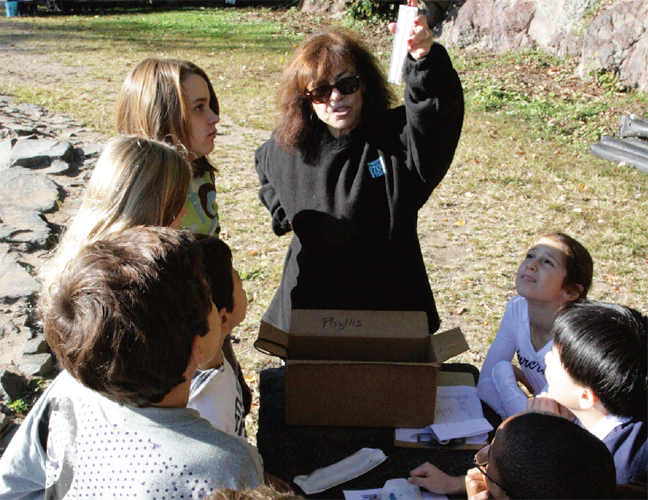
As our school sits in the middle of two significant watersheds (the Hudson River drainage basin on the New York side, and the Hackensack River drainage basin on the New Jersey side, which flows into the meadowlands around Secaucus), studying the Hudson River forms an important component of the developing, environmental education curriculum at The Elisabeth Morrow School.  To that end, back in October, forty excited fifth graders visited the Alpine Boat Basin for the annual, “Day in the Life of the Hudson River” fieldwork trip.  This event was coordinated by the “River Project,” and was part of a multi-institutional effort to raise awareness of The Hudson River, increasing appreciation of its vital importance and value in our daily lives. 

Involving groups that ranged in age between elementary school children and university researchers, students were asked to take careful measurements of a variety of parameters that would be a sign of the state of The Hudson River. The data collected would then feed into a central database to be analyzed and interpreted, thus providing a meaningful study of the dynamics of the river and an understanding of the river’s “health.”


Elisabeth Morrow students were engaged in careful measurement of water quality parameters, such as, salinity oxygen levels and percent saturation, water temperature, nitrate levels, pH levels (acidity), chlorophyll levels and turbidity (the clarity of water). In addition, observations were made of prevailing weather conditions, such as cloud cover, wind speed and direction, and air temperature. Physical changes, such as tide changes and current speed, were also determined. Our students also had the opportunity to use a seine-net, allowing them to capture and identify fish from the Hudson River estuary.  In the past, we’ve caught a diverse array of fish, but this year only managed to capture white perch and silversides.


The Hudson River study has been a recurring aspect of the fifth grade science and social studies curriculum for a number of years.  The value of this fieldwork cannot be underestimated, since it introduces students to the direct, hands-on techniques used by scientists as they conduct their own research in the field. Such applied research also develops important skills: observation, recording, and predicting. 

“The Day in the Life of the Hudson River” is just one of the ways Elisabeth Morrow uses our local environment as an outdoor laboratory.   Throughout the entire school, we want our curriculum to develop in our students a sense of wonder and appreciation for our temperate biome and the ecosystems that fall within it.  Our third graders, for instance, study The Hackensack River Watershed and go every year to the Meadowlands for a boat trip where they learn about the tidal wetlands and witness the impact of humans on the environment. 

Even our own campus serves as a valuable workshop.  Our students use the Wharton-Lessin Forest and the associated brook as study sites for environmental activities.  We have constructed a pond to complement our studies of the brook. The pond has several catfish, some goldfish, numerous frogs, including developing bullfrog tadpoles and (we hope) two surviving red-eared terrapins.  Students learn how to manage the pond and that it is also maintained by rainwater runoff.  Elisabeth Morrow also has a bathhouse, a weather station, and a number of gardens.  

In the vegetable garden, students have sown and harvested squashes, tomatoes, Indian corn, sunflower seeds, beans, basil, potatoes and much more.  The vegetables are then used to prepare delicious meals in our school kitchen.  As well, pokeweed berries and acorns have been harvested and used to produce dyes for wool, then knitted or weaved into fabric.  We also have a wildlife friendly garden that provides splendid displays of color along with a variety of blooms and blossoms. These gardens also attract a variety of animal species to our campus: cautious deer, tentative turkeys, cunning and furtive red fox, malodorous skunks, cute cottontail rabbits and corpulent groundhogs have graced our garden. Students use these gardens for research and observation.  Maintenance is also important, as we pass through the autumn equinox; students learn to prepare for the next growing season.  Leftover material from the gardens is composted and the students begin to plant colorful bulbs for next spring.

The Elisabeth Morrow School has easy access to the Hudson River, easy access to many parks and preserves in our region, and even easier access to our own small biome on campus, just outside our classroom doors.  Very convenient, true, but more importantly our students are able to experience environmental science directly; beyond just reading or seeing, our students are doing.  Clearly, when students are active participants in the lessons, the lessons have greater impact.  To keep matters in perspective, we know that preparing students for high school, and eventually college, has taken on new dimensions in the twenty-first century.  As important as it is to get our students thinking globally or using technology effectively, we must also educate our children about the environment, as many signs seem to indicate that conditions are changing drastically.  The Elisabeth Morrow School has taken significant initial steps to making environmental science and stewardship an integral part of its curriculum.  And not just a class here and there or a dedicated club or two, we are trying to make sustainability and environmental studies part of our core, from age three to grade eight, in hopes our students will carry with them a lifelong understanding and passion for protecting the planet. 

A Living Curriculum: The Hudson River as Historical Resource


by Sanda Cohen, Phyllis Grossman and Jackie Riley
Fifth-­Grade Teachers


Winter 2010


Anyone familiar with the Hudson River’s history knows that it served as a vital highway into the continent for merchants and military in the early days of our nation.  And, having the Hudson River within a few miles of our campus offers our students an incredible opportunity to interact with and experience a landmark that played a significant role in the development of our country. 
Beyond reading about the river, we try to have our fifth graders experience it.  On trips to Stony Point Battle Ground and the United States Military Academy at West Point, they were asked to walk along the water’s edge imagining the area free of buildings, bridges and roads, while discussing the imposing beauty of the river valley Henry Hudson and his men would have observed, 400 years ago. Our visit to these sites also provided us with an understanding of the river’s military importance during the revolutionary war as these locations played strategic roles in hindering the British from transporting vital supplies between their Manhattan base and their forts upriver.   Seeing the Hudson River Chain and the open views of the river for cannon fire helped the students see the strategy used by the Continental Army to prevent British boats from passing.  
On other trips, to Greenbrook Nature Sanctuary and on a sailing trip up river on the Hudson River Sloop, Clearwater, our fifth graders explored first-hand the various habitats and societies connected to the river. They also learned about the environmental importance of the river, the role it plays in our lives today, and gained appreciation for the people who have dedicated their lives to keeping it clean.  
In our study of the Hudson River, we feel that it is vital that we establish a sense of continuum; to experience and to understand this significant region as it exists over time.  This can not be done with just text books or the internet.  That’s why at Elisabeth Morrow, whenever possible, we make strides to bring our students on-site, to the scenes where history happened, to the locations that hold meaning for our society. In this way, our students move beyond the classroom and the places we visit, like the Hudson River, become essential resources within a living curriculum. ­­