Showing posts with label Chilton House. Show all posts

The Value of Conversation


Beth Anne Brennan
Lower School Head

This Thanksgiving, after a vivacious and delicious meal, my friend Steve pulled me aside in the kitchen.  He smiled and said how reminiscent this holiday had been to his own childhood.  He delighted in hearing my father tell the family stories of past holiday celebrations, including the details of the “cast of characters” sitting around the table and the shows we put on as children for our very proud parents and relatives. 

“Hmm?” I thought. Nice to hear, of course, but I never really saw it this way.  For Steve, our lively discussion around the Thanksgiving table was a treasure. For me, time spent talking was a typical occurrence in our household.  As a family we have grown used to joining my father in the living room, sitting on the couches, engaging in conversation.  And my father is a pro:  he instinctively knows the right questions to ask and listens with genuine concern to all of the details and topics of interest in our lives.  He offers advice, shares a story from his life experience that adds substance and meaning to the conversation, and makes positive observations that encourages us all to want to stay engaged. 

Now, not everyone’s like my father, I realize.  He’s had years of practice.  Yet, given the time to reflect upon the festivities of this past weekend, the heartwarming union of family and friends, I think Steve has the right perspective.  Conversation is a treasure.  In this regard I consider myself lucky.  I grew up in a household that valued conversation and made it a priority.  Now, today, it is easy for me to see the gains of having parents who wanted to talk with me as a child.

You may be thinking “that was then,” right?  After all, these days it seems it’s tough to find the time.  Most of us have very scheduled and hectic lives, along with family-wide access to the various media channels that draw our attention.  It is a facet of the era in which we live, but we have to keep in mind that the time we spend disconnected or disengaged with the members of our family, with our children in particular, we not only miss those moments that enrich our lives and allow us to bond with our kids, we also lose the opportunities to develop their character through conversation.

Engaging your children in conversation not only expresses your love by showing interest in who they are and what they have to say, it also provides them with a model for listening, speaking, and asking.  Among other things, conversations also teach children to absorb or form opinions, frame perspectives, and develop empathy.  Although it may not be easy to initially connect with your children, perhaps provide them with a topic of mutual interest and encourage them to carry on lively discussions by sharing their ideas or asking questions.  And stick with it; try not to give in to any initial grumblings or indifference.  Try not to succumb to the “easy way” by handing/allowing them a device when they jump in the car or sit down for dinner. As an educator and as a mom, I can’t stress this enough: conversation is a critical social skill and part of child’s development that requires adult patience, modeling and practice.  So the next time you sit down for a holiday meal, or any meal in fact, seek to find this treasure.  I assure you, it’s worth it.

Top 5 Tips To Plan Successful Play Dates


by Beth Anne Brennan
Lower School Head


I was in my office the other day, well beyond the hour I had intended on staying, when I got a call from my younger sister.  A nice surprise, for sure, but when we moved beyond casual conversation, she got to the heart of why she was calling.  She wanted to get my thoughts on a play date that went badly.  No need to go into the details, but being a parent of four children myself, the host of many play dates in my time (some successful, some not so much), along with having a career where I am surrounded by children, I did have a few thoughts on the matter.

Although in the moment, after a not-so-great play date, every parent’s first response is likely, “I will never have that child over again!”  An experienced parent, however, knows that probably won’t be the case.  Children love the idea of having play dates and honestly, as parents, we generally want to see our children having fun and enjoying the company of their peers, but sometimes tempers, impulses, and demeanors can get the best of any child during play.   Although there is no magic formula to make a play date great, there are steps you can take to help insure they go well.

At the recent NJAIS conference, I ran into Dr. David Lowry, former EMS Head and respected colleague; he reminded me in a conversation that parents love lists.  Here, then, is a quick list of play date tips; may your meetings with fellow friends be happy and successful experiences for all.

    Let your child have a say as to whom he/she wishes to play with. When they were younger we made our children play with our friends' kids.  As they grow, however, encourage them to choose their own friends, perhaps ones that have similar likes, interests or hobbies.

    Invite the other parent in.  Many parents want to get to know you better before leaving their child in your care.  Invite them to your home and talk to them about your expectations.  Get any contact information and special care information and ask them if they have any suggestions that may be helpful in setting the tone for successful play date.

    Set rules. Tell the children what the "do's" and "dont's" are for your home.  Keep the list short.  Suggest to your child, ahead of time, to put away any toys he/she is not willing to share.

    Prepare for the meltdown. Keep play dates short and be ready for the worst.  Some children will test limits, so be prepared as to how you will handle any and all situations. 

    End on a happy note.  Try to help the children achieve success in their play date by ending on a positive note. Should anything have happened during the visit, be open and honest with other parents.  

      Remember, we as parents host play dates so that our children can practice socializing with their peers.  Do not expect reciprocity and remember that you can say “no” if a day or situation does not work for your family.

For more detailed information planning great play dates read:
Jennifer Rodecki, M.Ed. and Deb Leach, Ed.D., BCBA:  http://bringingaba.blogspot.com/2012/05/5-tips-for-successful-play-dates.html

Beginnings and Endings - The All School Gathering


by Patricia Eickelberg
Early Childhood Teacher

What better venue than the All School Gathering to congratulate all of the 8th graders and wish them well.   All of their school peers, from C-1 three-year-olds to the soon to be moving up 7th graders were there to cheer them on as they leave EMS to begin their high school years.

We also said goodbye to the faculty and administrators who will be leaving us.   We acknowledged those leaving by sharing with the students the length of time each of those faculty members has been with us.  Mrs. Phyllis Grossman, who has been a teacher here since 1980, was the last to sit down.  It was a great feeling to hear the whole student body express their gratitude for her devotion of 32 years as they clapped and cheered!

Once again, the focus of the Gathering was to show everyone how connected we are, in spite of our separate divisions, buildings and responsibilities at EMS.   One of the highlights of our “Connection Circle” was a demonstration of how just one teacher, Mrs. Susan Labita, has touched the lives of 95 current students who started at EMS in the three-year-old class.   Even Mrs. Labita was amazed at how many students stood up as we called their names!  Most impressive of all is that two of our graduating 8th graders were fortunate enough to have started with her in the Three’s.  Casey McConville and Abby Rivior have experienced every tradition in each grade, from the Englewood Boat Basin trip when they were 3 to their recent 8th grade trip to Washington, D.C.


The All School Gathering, as an event at EMS, is still in its infancy.   Its purpose, simply, is to bring the entire student body, faculty, and administrators and staff together. Coming together allows us to see siblings and friends, faculty and staff, as well as all of the other people behind the scenes at EMS.   Our plan for the All School Gathering is to have them more frequently–we feel that coming together more often will strengthen our community and build stronger bonds between the divisions.

New Parent Dinner 2012 - Welcome New Families

by Blair Talcott Orloff
Director of Admissions and Financial Aid


On Thursday, May 31, The Office of Admissions and Financial Aid hosted its second annual New Parent Dinner in the Morrow House Music Room.  The evening began with a cocktail reception on the patio outside the Science Wing followed by dinner in the Music Room.  The weather was perfect and the event helped our new families to make connections with members of the community, including the Parents Association, Faculty and Staff.  A thank you to everyone who helped make the evening such a success!

The Experience of Research in Kindergarten

by Beth Brennan
Director of Early Childhood Programs


This spring, our EMS Kindergarten classes have been using their acquired literacy skills to begin their first, school research projects.  As with all projects of this nature at EMS, the teachers are merely guides while the students are encouraged to take ownership of their research and presentations.


Initially, the children are instructed to select an animal.  Next, they are guided through the research phase.  The teachers assist in selecting a variety of books (non-fiction), provide video clips and apps to use with iPads, and help with fact-finding during library visits.  Students are also provided with a list of general questions as a framework for their research; this also helps them process their findings through notes or images they sketch.  Experience is also important, so very soon, the children will be visiting the local zoo to study their animals in person. 


Projects such as this one are multi-faceted, engaging a range of methods for gathering and processing information.  From a farther perspective, "research" gives young children a sense of purposeful study–it  forms a body of skills and pattern of thinking as children move through school and are confronted with problems or topics they must break down and understand.


Engineering Cars in Prekindergarten


by Beth Brennan
Director of Early Childhood Programs


Wood was cut and holes were drilled, all in preparation for a very special design project last week in our Pre-K class.  The children were challenged by their teachers to come up with designs for wooden vehicles that move.  Once the designs were in place, the students set out to sand, stack, build and glue pieces of wood together to make their cars.  Vocabulary like axles, wheels, and hub caps were incorporated in the building portion of the lesson. In projects like these, the process is as important as the end results; the children start with imagination, followed by the development of a plan, then trial and error. Once assembled, as you will see in this video, they had the opportunity to talk about their ideas and, best of all, test their vehicles. 

Large Motor Development at the Art Table in the Three’s Classroom


by Tricia Eickelberg
Early Childhood Teacher


The three-year-olds of C-1 recently painted marble pictures using daffodil colors. In order to move the marbles around they needed to tip the box from side to side and back and forth. On another day, they also helped paint our pond by using rollers to spread the paint over the paper. They then used texture tools to make the waves in the water. 


Children generally enjoy active projects like these–they're fun, they're making art–but the overarching goal here is to strengthen muscles in their upper arms. Later, when they begin writing, these stronger muscles will help with both proper pencil grip and with the ability to move the pencil across the paper.

"High-Order" Reading


by Beth Brennan
Director of Early Childhood Programs

Recently, I read an article called "Using Higher Order Questioning to Accelerate Students' Growth in Reading" by Debra S.Peterson and Barbara M. Taylor,* from this month's issue of The Reading Teacher.  With regard to student reading, the authors stressed the importance of facilitating "high-order" discussion and writing to promote deeper thinking in students: So, in essence, teachers need to engage student readers beyond simple factual analysis and at more of an analytical, abstract or inferential level.

This is precisely the subject matter we tackle during grade-level meetings and professional development days at EMS.  Our teachers regularly assess to what extent they are engaging students in rich and thoughtful reflection, or to what degree their students are thinking critically about the reading.  The hardest part we find (perhaps for any educator) is having the willingness or confidence to move text discussions away from "teacher instructed" to "student centered." This is challenging; it is very easy to just provide answers, but it takes a great deal more effort to move students toward meaningful analysis or discussion. And, it is very important that we do so if we hope to promote and cement higher-order comprehension. 

* - This article is protected by copywrite and therefore not available via direct link.  A PDF may be purchased through the Wiley Online Library.  The abstract is available here.  If you wish to read this article, contact me and I will try to provide you with a copy

Independent Early Childhood Programs: A Seamless and Cohesive Education


By Evan Brown
Director of Communications and Alumni

January 2012

For parents, selecting a primary school for their children is a far more significant decision than they may realize. Unlike secondary or post-secondary schools, where the duration of a child’s stay generally ranges from 2 to 5 years, traditional primary schools usually offer an education program that spans 8 or 9 years and may expand to 10 or 11 years if the school offers middle school education.  This represents a significant amount of time within a child's development.  Selecting the right primary school that will nurture a child from toddler to teenager and offer an excellent education across the board is a definitive choice parents must make.

The belief that a child should receive a seamless and cohesive education, rather than a fragmented experience in which a child most be moved from school to school, is one that is near and dear to The Elisabeth Morrow School’s Early Childhood Director (Englewood, NJ), Beth Ann Brennan.  "In schools like this one, the program supports all areas of development: cognitive, social and emotional. The environment is comfortable and familiar, and we continuously educate children to get to a place where they are ready for that next level of learning."

Often, the biggest concern for parents selecting a primary school is that the instruction may not be rigorous enough, particularly in the child’s earliest years.  Parents may worry that an education that promotes “play-based” learning will fall short.  However, recent studies show that such views may be baseless, as "play" seems to be crucial in the academic development of children.  Brain-based education expert, Dr. Kathy Nunley sums up the current research:  "executive function skills can be improved in pre-K programs by using social pretend play to increase a child's ability to inhibit internal and external distractions. Play and story telling can also be used to develop strong working memory, which will be used for things that unfold over time, such as reading and mental math.”  Play helps young minds focus and organize, preparing them for more challenging or demanding tasks that come in later grades.

Ms. Brennan of The Elisabeth Morrow School affirms that during the child’s earliest years, learning must be engaging for students; for learning to be engaging, it must be fun: "A real and authentic play-based program that carefully entwines developmentally appropriate and engaging experiences allows for curiosity and discovery. The ‘fundamentals’ are then introduced, practiced and mastered when and where it is appropriate within the curriculum." 

Ultimately, early education programs must feature faculty that are dedicated and committed to the progress and holistic development of the child.  Echoing this sentiment, Ms. Brennan states, "the cornerstone of such programs, and certainly here at Elisabeth Morrow, is that the faculty understand the age they are teaching (cognitively, socially, emotionally) and know how to guide them in their education."

Good Morning Mr. Cooper: Q & A With Elisabeth Morrow's New Head of School

On November 17, 2011, The Board of Trustees appointed Aaron C. Cooper as Head of The Elisabeth Morrow School, replacing David M. Lowry, Ph.D., upon his retirement at the end of this academic year.  Mr. Cooper will become Elisabeth Morrow’s seventh Head of School.  A few days after his appointment, Mr. Cooper sat down with Jennifer Brown, a reporter and writer for CBS Radio News, to share his thoughts and views regarding his appointment, the School and its future. 


Jennifer Brown (JB):  When you first got the news that you were hired as the new Head of School, tell me what you were thinking?

Aaron Cooper (AC):  It is something that Kara and I had spoken about quite a bit, particularly since Dr. Lowry announced his retirement, and we knew that this was a possibility.  The announcement for me was somewhat surreal, as it happened after a Board meeting where I had given a big presentation.  After the meeting, I was asked to stay, and the Board Chair came in and offered me the position.  I was thrilled.  So, after being at this school now for nine years, knowing it really well, and having put a lot of thought into what can be the right next steps for the school, it is exciting for me to be the person who can help steer it in that direction.

JB:  Looking at your bio, I realize that you have done just about everything at this school:  you have coached, you have taught, you have helped these students find high schools. What made you seek this position?

AC:  I can trace my aspiration to be a head of school back to my first couple of years in teaching.  I loved being in the classroom. I took to it right away from the standpoint of being able to create, maintain and enhance – to put my mark on a culture of learning and respect.  After several years in the classroom, though, I started to feel the desire to have a similar effect on a larger scale.  To me, as a head of school, that is job-one; the person in this position drives, supports and formalizes a culture conducive to everyone's learning.

JB:  About your early years teaching, do you have any fond memories so far at Elisabeth Morrow?

AC:  I have been through much at this school, starting here when the school was just nursery through sixth grade, and then eventually adding seventh and eighth grades. One memory that stands out is the first boys’ basketball team that Gene Love and I coached.  You should have seen the look on the boys’ faces when we won our first game.  They were so excited and proud of their school.

The previous year, I got to know all of my players well, as I had them in my sixth grade Latin class.  So, personally, this win meant a great deal to me as well.  I was hired to help design the Middle School program where one facet was the creation of extracurricular programs, including sports.  It was a great deal of work.  We brought in advisors, we had committees working on it, we devised a philosophy for the sports program and then we got to watch that come to fruition.  The first win was a great moment, seeing the students jumping all around at center court in their green uniforms and it being here on campus.  It felt like the middle school of EMS had arrived.

JB:  What is it like having your children attend Elisabeth Morrow? What’s your perspective as a parent?

AC:  Julia is now in Kindergarten (she started in the three-year-old program) and Charlotte just started in the 3's program this year.  So this is the first year that both of our children have been old enough to be in the school.  I appreciate the fact that I get to work in the same place that my kids go to school.  When I drive to work, I get to drop them off, walk them down to their classrooms and say good-bye.  Then, at the end of most days, I am able to pick them up after school and take them home.  Before and after school, I get to hear what they are looking forward to or what they did that day.  You can't put a price on that; it is invaluable.


Julia started the year I was promoted to Assistant Head of School, and that was significant for me as I moved away from being a Middle School employee to being a whole-school administrator.  My initial task for this position was to become more familiar with elementary and early childhood education, as my background had been exclusively in middle school education.  The combination of learning the position through my contact with teachers and principals, along with my experience as a parent watching my daughters go through this program and the effects that it has had on my girls' learning has very quickly helped me understand our program at a much deeper level than I would have otherwise.  For instance, my daughter Julia has been here three years now, and to see her go from entering the school in the 3's program, having been just potty trained to being now, in Kindergarten, on the cusp of literacy – of reading and writing – has been wonderful.  I have enjoyed observing how all the different pieces of the program have worked together to help her get to this place.  She loves everything about language:  playing with words, telling and listening to stories, predicting their endings.  To see that come to life in my child has been fantastic for me as a father and an educator.

JB:  You have kids here, you've worn a great many hats here, and it is clear that you are familiar with the school.  What challenges do you see heading your way next year?

AC:  There are challenges and opportunities on a number of levels.  One of our biggest challenges, which is over-arching and connected to all others, is maintaining and enhancing the sense of community that we have, both internally (between the faculty members of the school) and externally (with our families).  We've seen a marked increase in the number of families where both parents are working full-time.  We are also seeing farther geographic distance from which our families are coming.  So it's important that this place feel like a home for students and parents.

JB:  There are some big projects in the works for Elisabeth Morrow, in terms of the campus master plan.  Tell me a little about that.

AC:  This segues perfectly from your last question, because the underlying motive behind this initiative is community. We’ve engaged an architectural firm to work with us to develop a campus master plan in conjunction with the Strategic Plan and to address our needs today as well as in the future.  One of our big challenges here on campus is geographical in nature.  The level of elevation within the campus separates us into lower and upper campuses and, to some degree, impacts the unity of our community and the feeling of being one school.

Also, with the advent of the Middle School, there is need for additional spaces.  For example, we do not have a regulation playing field where we could host interscholastic games on campus, nor do we have a large multi-functional space for the whole school to gather, meet and celebrate as a community. 

Our intent is to develop a specific plan to meet these needs and others while creating a common area which would unify the campus and benefit the entire school.  This design more accurately reflects our spirit and our mission.

JB:  So let’s turn toward the Strategic Plan. This is more about program?

AC:  It's a bit more all encompassing than that.  The Strategic Plan is the Board's blueprint for the future initiatives and direction of the School.  While it speaks toward programs both academic and non-academic, it also includes human resources, technology, enrollment, and communications – basically providing direction for the School as a whole.  It becomes the document that will steer our work as faculty and administrators.  Now, as Head of School Elect, I will play a more active role in helping to articulate the different goals that we believe will make us as strong as we can be.


JB:  Well, let's talk about technology a bit.  There is so much new technology, new media, social networking – it's changing the way schools are approaching education.  There's a lot of talk about "no textbooks." There is a lot of talk about going "paperless." Kids are learning much more electronically.  Where do you see current trends fitting into Elisabeth Morrow?

AC:  I have a lot of thoughts about technology in education.  In general, I see technology as a tool that is used to enhance learning and it can have a number of different facets.  Within our curriculum, I view us using technology to develop deeper, more significant connections between our students and what they are learning.  Two instances come to mind.  When a class is learning about other parts of our country or the world, it's easy to gather information and even talk to people who live in those places or are involved with those places.  Using technology to garner those global connections and awareness is something we want to develop further.

From a more practical angle, technology is a great organizer, in terms of information and applications.  One thing we are currently discussing is the use of a "device" to hold all your textbooks, hold all your notes and hold all your work that is accessible anytime via the "cloud."  Not only does that make the backpack lighter for the students, but this way of managing and referencing information is also more relevant to the world today and more relevant for the kids growing up in this world.

JB:  When I think about all this new technology, it takes training.  How do you see yourself as Head of School supporting your teachers in this regard?

AC:  This is actually something I have been working on closely as Assistant Head.  We've formally established a faculty evaluation system.  We call it Faculty Growth and Renewal, and concurrent to that I have been working with Sarah Rolle, our Director of Technology, to set up our expectations for faculty learning about technology.  It has evolved from a series of training sessions, and it's currently a more teacher-driven program.  Teachers target their own initiatives, and our technology team then assists them in the training they will need.  It has become much more individualized.  As Head of School, my expectation is that we all need to be learning technology – each person needs to take his or her next steps, and there are always next steps.  This way we can deliver the program in the most powerful and relevant way possible. 

JB:  Is there an example of technology use in the classroom that you think has been particularly successful?

AC:  I have two that come to mind.  One is in the second-grade study of culture.  They have actually made connections with other schools around the world and have been in regular contact with a school in Australia working on a joint project discussing the differences between Australian and American culture. Our students have even “Skyped” with the teachers there, despite the 14-hour time difference.  So there's technology being used as a collaborative tool, connecting our students with children literally on the other side of the globe.

The second example is the work we are doing in the Middle School with virtual worlds, online gaming and scripting.  It has been phenomenal.  It is not so much about the content, but rather more focused on the skills students will need today, in terms of creativity, collaboration, communication, forming of community and character.  All of those pieces integrate nicely within these types of games, and the students absolutely love them. So, there is a high level of engagement. The Elisabeth Morrow School is on the forefront of this initiative within independent schools.

JB:  So when you say “scripting,” do you mean games where you read along and make choices?

AC:  No, scripting is synonymous with programming. Students can use programming language within the game to affect how the game goes, such as building a certain structure, animating certain features, moving from one part of the virtual world to another, or inventing the landscape within the game.  Students do this within teams and try to solve the challenges that exist within the virtual world.

JB:  Something I read about every day in my job, as pertaining to schools, is bullying.  Basically, parents feel like bullying is all over the place, at school, in texts, on Facebook and that schools don't do enough.  The statistics for middle schools are alarming; that this starts at such a young age, affecting both boys and girls.  With your middle school background, what's your take on it?  What do you feel needs to
be done?

AC:  I think the most important thing for the school is to establish a safe environment.  I think this is something that we value and have always done quite well.  If you look at the 4 C's (cooperation, consideration, compassion and courtesy), we have made this integral within our community from the youngest levels.  We also offer programs such as Advisory and Responsive Classroom that help students connect with one another.  This, along with the knowledge and care our faculty has for each individual student, which goes beyond any other school with which I have been associated, are dramatic steps in offering our students a safe environment.

Beyond that, we know that there may be incidents of students being mean to each other, teasing and bullying.  What needs to be done (in fact, what we have already done) is draw a line in the sand and set a firm policy.  For instance, as part of our anti-harassment policy, we have an external component.  We know that bullying can and does take place beyond our walls, so we have decided to make individual responsibility and integrity our business. These incidents, which can occur online, outside our academic day or off campus, filter back into our larger community and can have a significant negative impact.  This weakens the community, so we need to be able to address this issue even outside the walls of our school. 

The other aspect is this: when an instance happens, the adults in the community must immediately address it.  As teachers or administrators, we must first find out what happened, and then we must determine the extent of it.  When we have this information, we then must communicate effectively with the students and their parents in order to educate and begin the healing process.  If it's bullying, genuine bullying, it’s a more serious issue – certainly nationwide it's an issue, and  New Jersey has passed new anti-bullying legislation.  Nevertheless, we have to able to separate when it's "kids being kids," or when it is actual bullying, with intent to hurt or harm repeatedly.  Of course, we have an obligation to teach our students how to manage their concerns within a community, but we have to be acutely aware when incidents become extremely hurtful or damaging.  This is our priority here, we must be consistent about gauging these situations, know where that line is and work together to make sure everyone's health, safety and growth are attended to.

JB:  Last question:  what do you want children to take away from their Elisabeth Morrow experience?

AC:  I would like them to take away two things.  I want them to have a sense of what their interests are, what their strengths are, what their budding passions are – a sense of how they learn and who they are as a person; so in essence, self-awareness.  I believe this is such an important element of their development, as they move from early childhood through early adolescence.  The other thing:  I want our students to have a joy of learning, loving to be challenged, loving to find out something new.  I want them to come away with a strong spirit of inquiry – searching out questions as well as answers – because having a passion for learning serves people very well in life and certainly within their academic careers.


A New Touch: iPads Come To Kindergarten

“We were looking for a way to be more innovative with technology in Kindergarten, making it more relevant at an earlier age. 

I thought, what could we do?  How can we change things up?

And I came back to Beth and asked, ‘What do you think about this?’” 
~Sarah Rolle, Director of Technology

By Evan Brown
Director of Communications and Alumni

Winter 2012

October 2010

I am sitting in Dr. Lowry’s office in our weekly administrative meeting talking about the articles for the next Appletree publication.  In a lull, I utter the following suggestion: “What about a technology article, or a story about the iPads in Kindergarten?”
    The intersection of school and technology is not new and certainly nothing new for The Elisabeth Morrow School.  We have computers in every classroom, in our libraries and four tech labs.  Our students use technology for everything from constructing avatars, interacting within virtual worlds, producing multimedia projects, and online collaboration to video conferencing with students, teachers and speakers from anywhere on earth.  Using technology in a meaningful way is a daily fact here.

May 2011

I am standing in a Kindergarten classroom.  I have my camera, intent on collecting photos for publications.  I am looking for compositions and there is so much to see in this classroom: abstract paintings and murals, colorful manipulative materials, beaming smiles, children deep in thought or interacting with peers.  Visually, I see that the children are making Mother’s Day cards, but I am not fully gathering the nuance of the curricular objectives here; I am not seeing with “teacher eyes.”
    One group of children is working on forming letters, carefully rendering their lines and curves in pencil to mimic the models presented.  Another group is drawing, cutting and pasting hearts and happy faces on folded, colored paper, embellishing their cards.  From time to time, a couple of students are called over to another table to work with letter formation on an iPad, tracing the lower case and capital letters with their finger.  All the while, teachers are moving among them, guiding, prompting, suggesting and pointing out when a job is well done and why that is important.  At first glance, there is nothing unusual here; we all made such cards when we were in Kindergarten.  I can remember, many years ago, cutting out the models from a Sears catalogue, gluing them to bright construction paper and scrawling a warm message to my mom: “You are the best MOM.” Some of the girls in my class would make the “O” in MOM a heart.

Wait! iPads were nowhere in sight when I was in Kindergarten.

You Have to Start Somewhere

In the early 1970’s, only a few Kindergarteners occasionally had the chance to peck away at the keys of a calculator, maybe adding a sum if they knew what addition was all about.  The rest of us were given two red blocks, told to find two more red blocks from a box, asked to put them together in a group, count them, and then realized that, surprise, two plus two equals four.  Maybe it is not too different these days.  Physical objects, like blocks and Cuisenaire rods, still work exceptionally well in teaching math concepts to young minds.
The difference is that teachers know that today’s young minds are born into a far more sophisticated age of personal technology.  Technology was not a major factor thirty-seven years ago, but today’s children need a very different skill set, a fact not lost on the faculty of Chilton House, home to Elisabeth Morrow’s Early Childhood Programs (ECP).
    When new technology enters a school, it is usually a top-down delivery.  The more mature denizens are likely to get the latest tools.  This is why it was so surprising to find the School’s first iPads in the hands of Kindergarteners.  ECP Director Beth Anne Brennan explains: “We want to use iPad technology in a way that has an authentic impact on young children, empowering their own learning, sharing with peers so they feel important and responsible.”
    Empowerment.  Cooperation.  Responsibility.  The Elisabeth Morrow School has always been very watchful and intentional when integrating technology within the curriculum.  For Elisabeth Morrow’s Director of Technology Sarah Rolle, bringing iPads into Kindergarten was about picking the best tool.  “Sometimes that involves technology and sometimes not.”  Ms. Brennan concurs, “We will always be grounded in child development here, but again, we need to ask how we can use technology in a way that is productive, engaging, meaningful, safe and fun, while protecting what Kindergarten is all about.
    Introducing iPads to very young children made sense physically, since the devices are a perfect size for little hands.  As Kindergarten teacher Rachel Simonson notes, “There are no peripherals to manage.  For most of the children, using a mouse effectively is still a challenge.”  The iPad works by touch, by pressing, swiping or dragging on the screen, allowing for a level of independence.  For Ms. Brennan, one of the more significant assets of adding iPads to the Kindergarten curriculum is their mobility. “We know that little children don’t easily move from one activity to another. Changing activities and locations repeatedly can make focusing difficult. Children do better when activities can ebb and flow within the borders of their classroom, and having the technology right here in the classroom supports this conviction.”
    Incorporating iPads into Kindergarten was not as easy as it might sound.  There was significant preparatory groundwork.  The Parents Association purchased the iPads in June 2010.  From there, the Technology Department “imaged” the devices, setting identical interfaces, protocols and apps on each device, which were then placed in the hands of the Kindergarten teachers. Throughout the summer, the iPads remained with the teachers. 
    Ms. Rolle explains, “I put on some apps for children as well as some for adults so the teachers would become comfortable with this new technology.  I experimented with a variety of apps, and if the teachers wanted to download more, that was great.  We held a training session in June, just to make sure they were comfortable when they left for the summer.  Once they were familiar with everything, we asked the teachers to look for apps that would be appropriate in their classrooms.”  From the beginning, teachers used a shared Google document to make notes about what apps were interesting, engaging or useful for specific activities.
    A trial run in the classroom came in the summer before the 2010-2011 academic year, when the iPads were introduced to Kindergarten teacher Janet Cohen’s Summer Explorations class.  Adds Ms. Rolle, “I sat down with her and the campers to see how they would respond when told, ‘This week you’re studying animals, now draw something.’  We learned quickly that the children needed to play first.  Although they could comprehend a drawing program and use their finger to draw, they just wanted to explore on their own.”
    In fact, as iPads arrived in the fall 2010, the teachers had to be mindful of their students’ enthusiasm.  “I was there with Michelle Goldstein on the first day,” says Ms. Rolle, “and it was the hardest thing.  She showed the iPad to everyone, and the teachers had to say what they always do, ‘you have to sit still, wait your turn and listen.’  The children rose to the occasion, showing us that they had the self control, despite the fact that there wasn’t enough time for everyone to get a turn that first time.”  Adds Ms. Goldstein, “They were all extremely excited. They all knew what an iPad was when they saw it. We needed them to understand how we were going to handle and use them. ‘This is how you hold it, this is how you turn it on, this is how you touch it.’  That was a concern for us.”
    “We had them use the devices while sitting on the floor,” said Ms. Simonson, “to eliminate a drop.  Or we had them use it in a nook, where it’s not easily stepped on.”  Beyond establishing the rules, “We found that the ones who were more comfortable with the iPads were really good at guiding the children who were not.  While there can be a fear that technology is isolating, we have not found that to be the case.  They like to see what others are doing.”
   
Teachers made another important discovery.  Says Kindergarten teacher Annie Hur, “It brought a new excitement to learning.  When we introduced iPads for handwriting, the children yelled, ‘iPads!’  Then, we would say, ‘Well, we’re only doing handwriting.’  Although we had been doing handwriting since the start of the year, the iPads infused the task with a new excitement.”
    With this enthusiasm, the students started to share their experiences with each other and teach one another how they got certain results on the iPad. “That’s a big piece of our assessment,” adds Ms. Brennan. “The iPads have allowed our students to think about and share processes more, because it is not always about the end product.  Critical thinking develops when students share and practice what they see others have accomplished.  We are always going back to the process.”
    “They do that informally right now,” says Ms. Simonson, “One child will ask, ‘How’d you do that?’ and the other replies, ‘Oh, I went into Cookie Doodle and this is where I found this, and that is how I did it.’ Which I think is terrific.”  Ms. Brennan explains that teachers already sit, listen and note what children are saying when they are working.  “This is where we assess their higher-level thinking and problem-solving skills.  When children have the chance to be the teacher, it really has an impact; they are empowered by their own learning, and when they share it with other children, they feel important and responsible.”

What Comes Next?


Sarah Rolle says to me, “I think that it’s your call how you focus your article. You can keep it centered on the iPad, but I think that technology has ramped up in certain ways because the Kindergarten teachers have been in the computer lab with the kids.”  She is right: there is more to it than just iPads, and herein lies the story, at least for The Elisabeth Morrow School, and maybe for schools in general.
    Technologies, like the iPads and the interactive white boards recently installed in many classrooms, are injecting excitement into teaching and learning.  Having tools such as iPads in Kindergarten affirms our belief that technology has a place at all levels in our school.  It energizes students and teachers and revitalizes approaches to curriculum for students who live in a digital world.   The success of iPads in Kindergarten had led to the introduction of iPads into first- and second-grade classrooms and into the Special Learning Programs this fall.

Intuitive Mathemeatics: Problem Solving at The Elisabeth Morrow School


By Aaron Cooper
Assistant Head of School


Summer 2010

My grade 9 students have difficulty appreciating the usefulness of the standard form of the equation of a line, prompting them to ask, ‘When are we ever going to need this?’ This question used to really bother me, and I would look, as a result, for justification for everything I taught. Now I say, ‘Never. You will never use this.’ I then go on to remind them that people don’t lift weights so that they will be prepared should, one day, [someone] knock them over on the street and lay a barbell across their chests. You lift weights so that you can knock over a defensive lineman, or carry your groceries, or lift your grandchildren without being sore the next day. You do math exercises so that you can improve your ability to think logically, so that you can be a better lawyer, doctor, architect, prison warden, or parent.  Math is mental weight training. It is a means to an end (for most people), not an end in itself.
~Dan Sherman  
(from the book “Made to Stick: Why Some Ideas Survive and Others Die” by Dan and Chip Heath)


The Three-Year-Old Program
How Can I Find Out?

On a May morning, a student entered her classroom to find a small group of classmates playing in the sandbox.  She counted five children (including herself).  She asked her teacher how many students had not yet arrived at school.  The teacher asked her if she could think of a way to find the answer to that question.  The student thought for a moment before walking to the cubby area.  After remembering which students were playing in the sandbox, she began counting the cubbies of the children who were not present.  Once she finished, she proudly announced that nine of the children had not yet arrived.  The teacher asked her how she came up with that number.  The student said she counted the cubbies of the nine missing children.  When she added those nine to the five children present, the answer was the magic number, fourteen (the total number of students in the class).


Kindergarten

Would I Be Able To?


Taking polls and making graphs has been a focus for the kindergarten students throughout the year.  Students are asked to answer questions by placing a colored cube in the appropriate column in a bar-graphing board.  For example, this year students predicted whether certain liquids would freeze in the winter (juice and paint, yes; oil, no) and in another example, identified their preferred Jack-O-Lantern face, scary or happy (scary was preferred by a landslide). 

One student in the class was planning a birthday celebration.  He wanted to make cupcakes for his class, frosted with each student’s favorite flavor.  He brought colored stickers and a list of his classmates to school one morning and set about taking a poll.  His teacher asked him how he was going to keep track of the group’s preferences.  Remembering his experience with graphing, he decided to use the same method to keep track of his classmates’ frosting choices for his special day.  He offered the choices, used the bar-graphing board along with the cubes his class had used all year long, and graphed the results.  The student noticed that chocolate was the most popular frosting, and his graph made it possible to see at a glance how many cupcakes of each flavor were required.


Grade Two
Did I Do Something Like This Before?

In second grade, our children develop problem solving skills in geometry by learning to identify and name various shapes.  In one activity, the students were given a set of four triangles and four rectangles previously cut from a four-inch square of paper.  The students were asked to name the shapes they saw and identify similarities and differences between them. 

The class agreed that all the triangles were congruent (in their words, “exactly the same size and shape”) and noticed that all the rectangles were congruent as well.  Then, the students were given a pair of scissors and a new, unmarked four-inch square piece of paper and asked to cut four congruent triangles and four congruent rectangles from it with no leftover paper (fig.1).  Teachers noted that there was plenty of extra paper, if needed.

Some students got to work folding and cutting by trial and error.  Others tried to envision the problem before beginning to cut.  One student tried to start cutting out shapes approximately the correct size.  After getting two triangles and two rectangles, none exactly the same, she was left with scraps of paper littering her desk.  A teacher approached her, and they started a discussion.  The teacher asked if she remembered the quilting squares project they completed a couple of week before.  The student did.  “Now, what shapes were on that quilt?  How did you make those shapes?”  The student remembered that there were rectangles and triangles and that she had folded the paper first before making her quilting design.  Off she went, folding and cutting.  Five minutes later, she proclaimed happily, “I got it!” and showed off her eight shapes with no leftovers. 


Grade Four
Is There A Pattern?

On a beautiful June morning, fourth grade students gathered in the Grace Muller Courtyard to work on a problem about King Arthur selecting a knight to marry his daughter.  At first, there were thirty knights around the table.  King Arthur eliminated every other knight, starting with the second knight and continuing around the table until there was only one knight left.  What was the seat number of the lucky knight?  

Students scattered in pairs around the courtyard, armed with sidewalk chalk and a copy of the question.  They drew circles, made slashes, used multiple colors and checked their work using different methods.  When they gathered together five minutes later, most had determined that seat #29 was the lucky seat.  

The second part of the problem asked students to figure out a winning strategy for a more complex game. If I were a knight wishing to be chosen to marry the king’s daughter, and I did not know in advance how many knights would be at the table, is it possible for me to figure out where is the best place to sit?  Can I show up the day of the competition, count the knights, think for a minute, and then take a seat that I know will make me the winner? 

Before the students got to work, the teacher asked what strategies they might use to solve problems like this.  Students called out possibilities.  “Draw it!” said one.  “Try to find a formula!” and “Use a calculator!” said others.  The teacher asked if the students remembered how they had solved a recent problem called, “The Ice Cream Problem.”  A student said, “We tried to find a pattern;  maybe that will work here.”  The teacher agreed.  

When the students scattered to begin searching for the pattern, they agreed on a systematic approach to solving the problem: start with one knight at the table, continue adding a knight and tracking the “magic” seat until a pattern emerges.  

It is quite a complex pattern but the students were able to get at it bit by bit. First, they noticed that the first knight wins again and again. Then, the students noticed that an ever-increasing sequence of consecutive odd integers gave the place of the winning knight. As can be seen in fig.  2, the odd integers, starting with one, repeat themselves to give the place of the winning knight. Each time, the string of odd integers lengthens. Eventually the students noticed that the first knight wins when there are two knights, four knights, eight knights….. and on and on as the number of knights doubles, beginning with two. 

After much discussion, they learned to predict the correct seat for a given number of knights.  While not explicitly writing a formula, the students realized that they needed to find the highest power of two that was a part of the number of knights at the table. The number left over from that power of two was the winning position!  Explicitly formulating the problem would require the use of logarithmic functions, a high school math topic often learned in pre-calculus courses.

Nevertheless, our fourth graders were able to appreciate the pattern and use it to model the problem.  This kind of thinking lays the groundwork for a much deeper understanding of such problems when encountered in more advanced classes, where the actual formula will be the end product of the exercise.


Grade Six
There Must Be An Easier Way

A sixth grade class starting their study of permutations and combinations had completed the following problem for homework: “The digits 1,2,3, and 4 are written on slips of paper and placed in a hat.  A three-digit number is drawn at random from the hat.  What is the probability that the three-digit number is divisible by the number three?”  

Students presented their methods for solving the problem:  “I wrote out all the possibilities of a three-digit number – there are 24,” and “I did 4! (four factorial - i.e., 4x3x2x1) to determine 24 possibilities.”  Another student noted that each number sequence (such as {1,2,3}) had six possible combinations and that no matter the order, each of those numbers will be divisible by three.  {2,3,4} was another set of numbers divisible by 3 with six combinations.  So, the class agreed that the answer was ½: 12 out of the possible 24 combinations would be divisible by three.  

During the ensuing conversation about how students checked their answers, a hand shot up from the side of the classroom.  “What if there were 1,000 numbers in the hat instead of four?”  Mathematicians love this type of question.  They call it the “natural” next step, a more difficult question of the same type.  The teacher, knowing that this is what mathematicians do, engaged the question. “Okay,” she said, “Let’s change it.  Instead of four digits in the hat, there are ten.  Zero through nine.  The other parameters are the same.  Get to work.”  

The students began by using the tried-and-true method from the original problem, writing out all the possible number sequences that are divisible by three.  As students called out numbers and the teacher wrote them on the board, some students began to wonder if they’d chosen the best method.  They asked, “How can we be sure that these are the only possibilities?” and “Is there a better way to do this?” “All this work, and we’ve probably got it wrong,”  said some.  Though the students made good progress on the problem, they soon discovered that their original methods were unreasonably time consuming and difficult for this extended problem. In the end, they were close.  The students found forty sequences divisible by three, yielding 218 combinations.  There are, actually, forty-two sequences yielding 228 combinations and a probability of 19/54 (approximately 35%) of getting a number divisible by three.  

When mathematicians encounter a similar issue – known methods being overly cumbersome, they have two options: automate the original method, if possible, or develop a stronger method.  The students’ recognition that there must be a simpler way to solve the problem and subsequent attempts to identify that method is an important step in the development of their mathematical minds.  

The solution requires a more advanced form of combinatorics, usually studied in high school pre-calculus classes.  The students saw how the more advanced problem is motivated from the simpler problem.  Further, they began to explore the more advanced problem and develop techniques for solving it. Both of these experiences should deepen their understanding of the topic when they come to study it in a more formal fashion in high school.


Grade Eight
It’ll Be Some Crazy Shape…Or, Maybe, A Parabola

Towards the end of the school year, an eighth grade math class began with the following pep talk:  “You all know a lot at this point in the year. Now, can you work on a problem that could use any of the things you’ve learned? Even if I don’t tell you which of those things you’ll need to use?  Trust me, you know how to do this.  It may look strange and feel strange, but you’ll figure it out.  You know how.” 


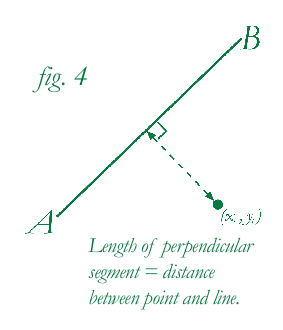
The teacher then asked students to remind one another about two concepts that they had derived the previous day: how one finds the distance between two points on a graph (fig. 3) and how to determine the shortest distance between a point and a line (fig. 4).  Afterwards, the teacher continued, “Good.  Now, suppose I have a point, F, at (0,4) and a horizontal line, l,  with the equation y=-4.  Find a point or some points that are equidistant from F and l.”  A student’s hand shoots up.  “I got one!  (0,0) is four units away from both the line and the point.” The teacher responded, “Excellent.  Now, can someone get another?”  

After a number of guesses – many close but none correct – students began thinking of the shape that might appear.  “It’ll be some sort of crazy shape...or, maybe, a parabola.” “Yeah, maybe the origin, (0,0), is on the axis of symmetry,” and “You could reflect the other points.”  The teacher re-centered them, “Okay, but so far you’re guessing.  Let’s find another point that we are sure about and go from there.”  

Another minute passed.  A different hand shot up.  “I got one! (4,1) is five units above the line and, if you use the distance formula, you find that it is also five units away from the point F.” “Very good.,” said the teacher.  Another student offered, “And its reflection, (-4,1), also works!”  Soon, another student had found two more points, (8,4) and (-8,4), that were also equidistant from F and l.  The teacher, cycling back to the students’ previous hypotheses, said, “Excellent. 

So, we have a lot of questions.  Is this a parabola?  Is it a parabola segment? Is it some sort of ‘V’ shape? What is it?  There are a variety of conjectures, but the strongest consensus is behind the idea that all the points together will form a parabola.  So, how do we confirm this conjecture? This is the next step.  Let’s take a sliding point, (x,y), that satisfies the given requirements, but that could be anywhere on the resulting shape.  Find out how far the point, (x,y), is from F and how far it is from l.”  

The students got to work.  After ten minutes of conversation, of building on one another’s ideas, of trying some thoughts that proved incorrect and others that proved helpful, the students were able to determine the distances that (x,y) is from F and l.  

They then realized that to get the equation describing the resulting shape, they would need to set the two expressions equal. The students had taken a similar approach when deriving the equation for a straight line earlier in the year. Although this problem was significantly more difficult, they were able to come to that realization with only very little reminder.

The next day, they completed the problem (fig. 5) and discovered that they had indeed derived the equation of a parabola (fig. 6).